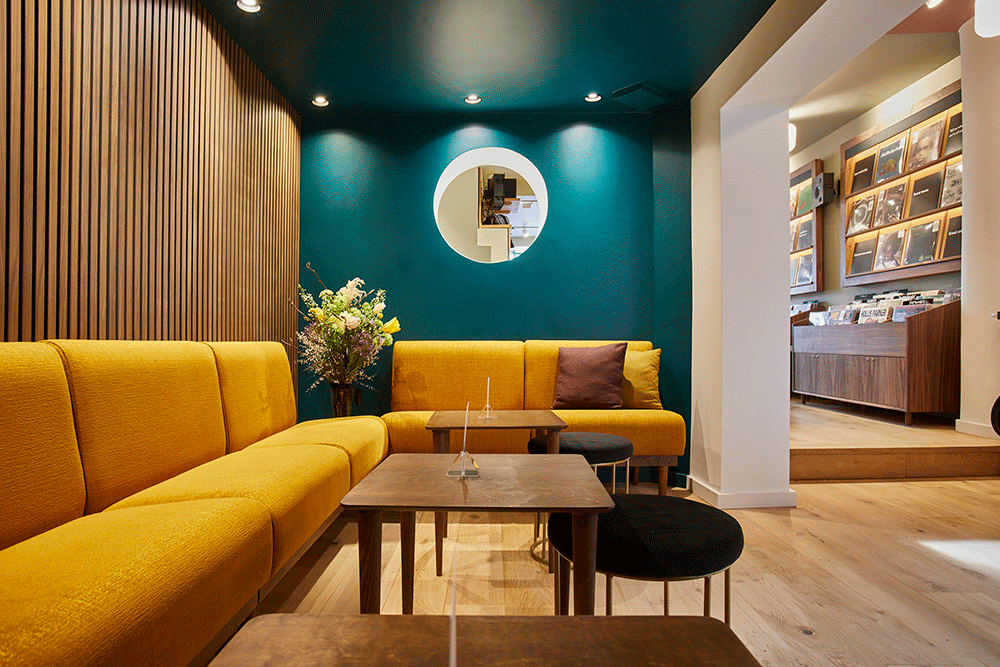
It is safe to say that at Engaging Interiors Limited wall panelling is one of our go to ingredients when making an interior more comfortable and engaging. Timber and fabric panelling help with an interior’s acoustic by breaking up the sound waves and having better sound absorption than other materials like plasterboard, tiles and glass.
However, decorative wall finishes also form part of the building’s internal lining, meaning they influence how a fire behaves within a room. In the UK, their specification is therefore governed by fire safety guidance within Approved Document B.
For designers and specifiers, understanding how wall panelling contributes to the spread of flame is essential to ensuring both regulatory compliance and occupant safety.
Why Internal Linings Matter
When a fire starts in a building, it usually originates in contents such as furniture or equipment. Once established, the fire can spread across surrounding surfaces. If wall or ceiling finishes allow flames to travel rapidly, the fire may develop faster and compromise escape routes.
For this reason, the UK Building Regulations require internal linings to limit surface spread of flame and heat release. Decorative panelling therefore needs to meet specific reaction-to-fire classifications depending on where it is installed within the building.
From Class 0 to Euroclass
Historically, designers specified wall finishes using the Class 0 rating from BS 476. This classification is derived from two tests that assess surface flame spread and fire propagation.
Today, the industry is moving towards the European classification system set out in BS EN 13501-1. Materials are graded from A1 (non-combustible) to F, with additional ratings indicating smoke production and flaming droplets.
In many commercial interiors, wall panelling systems are specified to achieve Euroclass B-s3,d0 or C-s3,d2, depending on their location and the building’s fire strategy.
Typical Requirements
Performance requirements vary across a building:
- Escape routes and circulation spaces generally require higher classifications, often Euroclass B.
- General rooms and offices may allow Euroclass C.
- Smaller or low-risk spaces may permit lower classifications in some circumstances.
Because commercial interiors often include open circulation areas, many designers adopt a higher standard throughout the scheme to simplify compliance.
| Euroclass | Typical meaning |
|---|---|
| A1 / A2 | Non-combustible materials |
| B | Very limited contribution to fire |
| C | Limited contribution |
| D | Acceptable but combustible |
| E / F | Poor fire performance |
Many designers now target Euroclass B-s3,d0 or better for wall panelling systems in commercial environments.
Design Strategies That Support Compliance
Design teams often achieve both aesthetic quality and regulatory compliance by addressing fire performance early in the design process.
Common approaches include:
Using fire-rated panel systems
Manufacturers increasingly offer pre-tested decorative panels with declared Euroclass ratings.
Applying fire-retardant treatments
Timber veneers and slats can be pressure-treated or coated to improve fire performance.
Reducing coverage in sensitive areas
Where higher classifications are required, designers may limit decorative panelling within escape corridors.
Coordinating with the fire strategy
Early collaboration with fire consultants helps avoid costly redesign later in the project.
Designing with Confidence
Fire safety regulations are sometimes perceived as constraints on creativity. In practice, they simply establish the framework within which good design must operate.
The best commercial interiors integrate performance and aesthetics seamlessly. When fire performance is considered from the outset—alongside acoustics, lighting and materiality—wall panelling can deliver both visual richness and regulatory compliance.
As with many aspects of interior architecture, success lies not in choosing between design and safety, but in understanding how the two inform one another.